
Kahnawà:ke First Kidney Walk


Opening the Conversation About a Disease That Disproportionately Affects Indigenous Communities
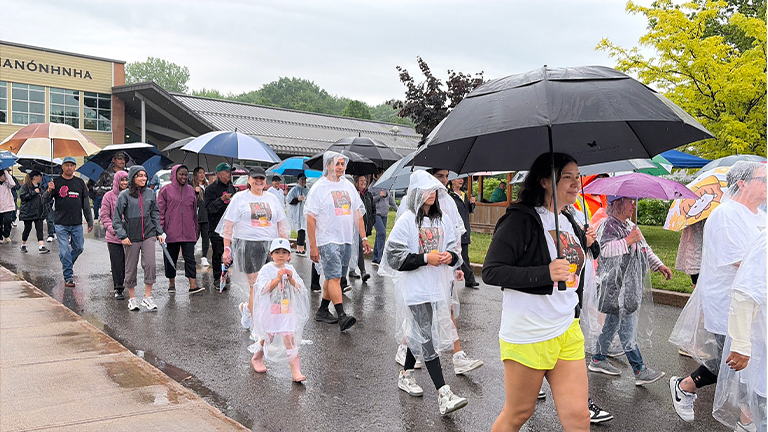
Under a rainy sky, but in a warm and unifying atmosphere, nearly a hundred people gathered on June 6 to participate in the very first Kahnawà:ke Kidney Walk. More than just a fundraiser, this event marked the beginning of a critical conversation around kidney health in the community.
Thanks to the mobilization of participants, local partners and volunteers, more than $15,000 was donated to the Kidney Foundation of Canada to support research, patient programs and awareness activities.
But beyond the funding raised, the real success of this first edition lies in the awareness it has generated.
A Little-Known but Widespread Reality
In Canada, kidney disease is increasingly affecting First Nations, Inuit and Métis people. Studies show that these populations are three to five times more likely to suffer from chronic kidney disease, due in part to a higher prevalence of diabetes, hypertension and inequalities in access to care.
These realities also come with additional challenges: limited access to services, distance from health care centres and often late diagnoses.
When Kidney Disease Progresses Silently
Steve (not his real name), a member of the Kahnawà:ke community, is familiar with this reality.
He learned as a teenager that he was living with kidney disease. Like many young people facing a chronic condition, he wanted to lead a normal life and ended up abandoning some of his medical follow-ups, especially since he did not feel any significant symptoms.
It was not until several years later that the first signs began to appear: persistent fatigue, shortness of breath and swelling. When he reconnected with medical professionals, his kidney function was only 15 percent.
Since December 2024, he has been receiving dialysis treatments three times a week.
Today, he wants to convey a message of prevention.
"A lot of people don't know they have kidney disease until it has progressed too far," he says.
His experience reminds us of the importance of screening, especially in people with risk factors such as diabetes, hypertension or a family history.
Breaking taboos to better help each other
During the discussions at the Kidney Walk, one theme came up several times: the stigma associated with kidney disease.
According to Steve, some people (including himself) are still reluctant to talk openly about their diagnosis, fearing that they will be perceived differently or that their abilities will be questioned at work or within their social circles.
This reluctance can have important consequences. When a disease remains hidden, it becomes more difficult to share information, encourage screening, or offer support to newly diagnosed individuals.
The Kidney Walk created a space where participants could freely share their experiences, ask questions and see that they are not alone in living with this reality.
Talking about kidney disease is a first step towards a better understanding of its impacts, but also towards reducing the isolation of patients and their loved ones.
Focusing on young people and prevention
The education of children and adolescents appears to be a key lever for reducing the future burden of kidney disease in Indigenous communities. Increased awareness could help reduce risks in the long term.
Steve believes that there must be more opportunities to talk about nutrition, kidney health and prevention in schools so that young people can quickly develop habits that are favourable to their health.
A first step towards a sustainable movement
This first Kahnawà:ke Kidney Walk was organized by health services and community partners, under the leadership of Mr. Arnold Boyer (Chief of the Mohawk Council of Kahnawà:ke), in collaboration with the Kidney Foundation of Canada, Quebec Branch. It brought together community members, families, healthcare professionals and local partners around a common goal: to raise awareness and take action.
"What mattered most was that people began asking questions" says Valerie Diabo, executive director of the Kateri Memorial Hospital Centre.
This first edition could well mark the beginning of a tradition that is set to grow, year after year.
Donations to the Kahnawà:ke Kidney Walk will continue to be accepted until the end of 2026. To contribute, visit the event's official website: Kahnawà:ke - 2026 Quebec Kidney Walk
For more information, please contact Mylène Boucher, Communications and Events Advisor, Quebec Branch. mylene.boucher@rein.ca