

Would you like to share your views to help improve programs and services for patients?
Participate in a Study
- Prioritizing strategies to support person-centered integrated kidney care
- To Tell or Not to Tell?
- Patient-Centred Approach to the Design of a Biosensor for Monitoring Kidney Function
-
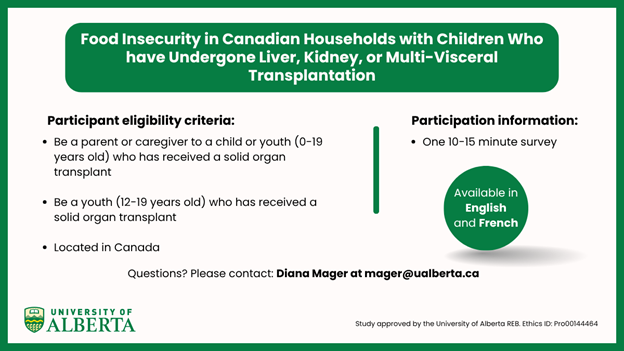
Food Insecurity in Canadian households with children who have undergone liver, kidney, or multi-visceral transplantation
Overview
Food insecurity – a lack of safe and adequate access to healthy food – affects numerous households across Canada. As a result of limited access to food, children in these households can experience significant health impacts, like poor diet quality, disrupted growth and development, and poor mental health. These factors are amplified for children who have undergone transplantation. However, little is known about food insecurity in households with children who have undergone transplantation.
Researchers out of the University of Alberta aim to address this gap in knowledge. They hope to:
Define what contributes to household food insecurity and
Understand the impact food insecurity has on children’s mental health, diet quality, and quality of life.
Identify/develop strategies and interventions to address food insecurity in Canadian households with children who receive organ transplants
Participation
If you would like to participate in this study, please complete the 10-15 minute survey in your preferred language:
ENGLISH: https://redcap.ualberta.ca/surveys/?s=PKDX8DHEEMFJN9XK
FRENCH: https://redcap.ualberta.ca/surveys/?s=WFMDEWYXXADN3MC4
Note: At the end of the survey, you can leave your email address if you’re interested in joining the phase 2 of the study (a 2.5-hr interview).
Eligibility
Be a parent or caregiver to a child or youth (0-19 years old) who has received a transplant (liver, kidney, or other organs).
Be a youth (12-19 years old) who has received a solid organ transplant
The study is open to participants nation-wide.
Study Contact
If you have any questions, please contact Diana Mager at mager@ualberta.ca.
This study was approved by the University of Alberta’s Research Ethics Board: Pro00144464
-
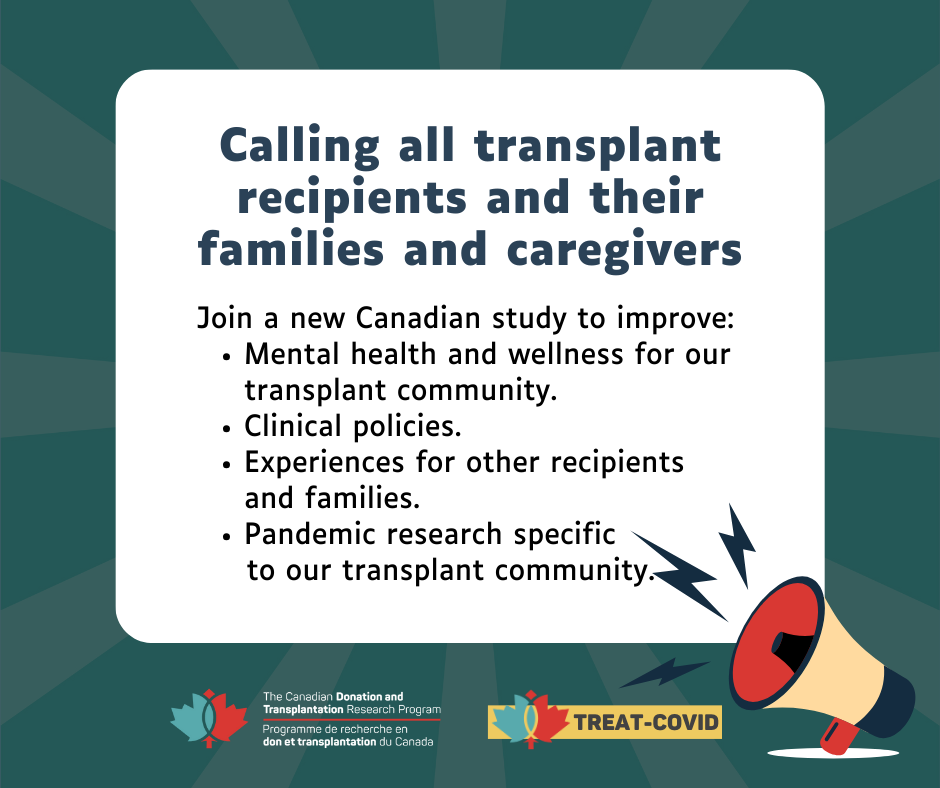
Addressing critical issues and emerging TheRapEutics in TrAnsplanTation for COVID-19 (TREAT-COVID)
Overview
Despite vaccination, transplant recipients remain at high risk of severe COVID-19 outcomes.
Recipients, families, and caregivers are also at higher risk of experiencing extreme stress and mental health concerns and bearing additional financial burdens.
Transplant recipients are often excluded from studies on COVID-19 due to challenges with study design, creating a lack of information and data.
For these reasons, the TREAT-COVID study aims to address these barriers by understanding how COVID-19 continues to affect child and/or adult transplant recipients and their families or caregivers living in Canada. This is in hopes of creating a flexible national plan to inform better policies and improve patient health.
For more information about this study, please visit: https://cdtrp.ca/en/treatcovid/
Eligibility
Be an organ or stem cell transplant recipient, or
Be a caregiver of an organ or stem cell transplant recipient*
Be followed by one of the participating transplant centres
*Please note that for a family member/caregiver wanting to enroll, the transplant recipient they care for must be enrolled in the study first.
Study Participation
Participating in this study will provide useful information about COVID-19 treatments and issues to policymakers, clinicians, and patients and their families.
This study is currently open to participants in British Columbia, Northern Alberta, Ontario, and Quebec. Please enrol through the link associated with your region:
British Columbia and Yukon: https://bit.ly/3WRUrqD
Northern Alberta: https://bit.ly/40Ix8Rj
Ontario: https://bit.ly/4kfqTMW
Quebec: https://bit.ly/4j9YGGA
Chinese Renal Association: https://bit.ly/3Q8G8KF
All other regions: https://bit.ly/3EA8n26
Study Contact
If you have any questions about this study, please contact Manuel Escoto at mescoto@cdtrp.ca.
This study was approved by the University of Alberta Research Ethics Board (lead institution): Pro00131530
- Food insecurity and diet quality in adults with Chronic Kidney Disease (CKD)
- Become a member of the Home First Dialysis Project Study Team
- Virtual patient advocacy volunteer opportunity